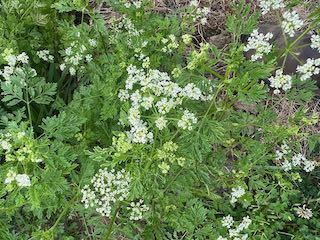
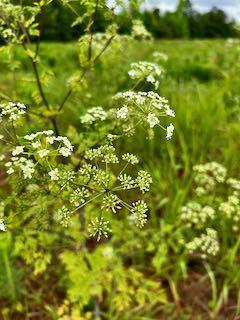
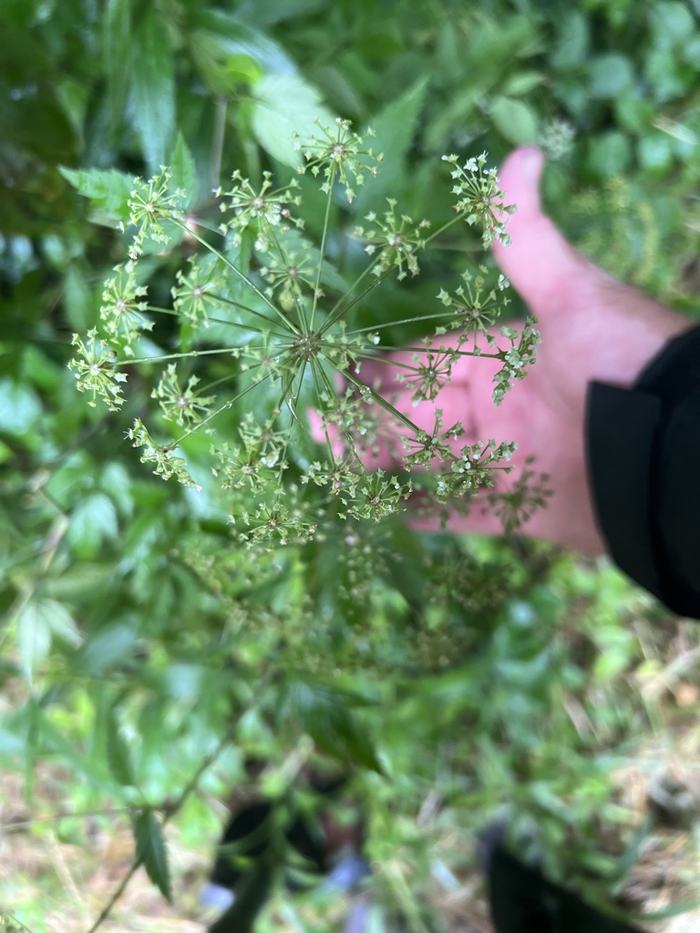
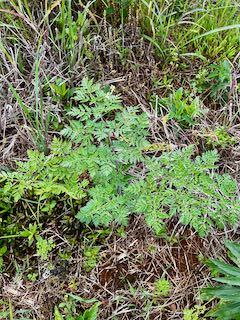
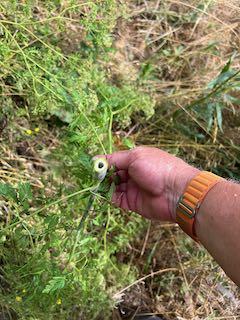
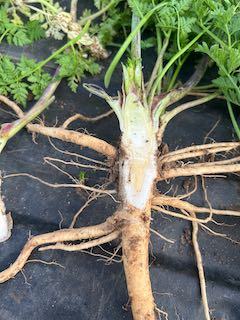
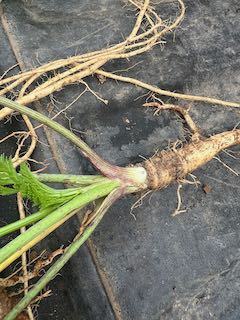
Two types of Poison Hemlock were found in Orange County NC.
Both Circuta maculata and Conium maculatum were positively identified. Circuta maculata is actually native to Orange County where Conium maculatum was discovered here around 1957. A resurgence of this dangerous plant can be found in multiple areas of the county.
Linked locations where these plants were identified in Orange County. (Thanks Izzie)
Cicuta maculata has multiple common names such as Cowbane, Poison Hemlock, Poison Parsnip, Spotted Cowbane, Spotted Hemlock, Spotted Water Hemlock, Water Hemlock. It is different from Conium maculatum.
Poison Hemlock (Cicuta maculata) is HIGHLY TOXIC, and MAY BE FATAL IF EATEN! It is a group 1 toxin and the plant is the most poisonous one in North Carolina. All parts of the plant are poisonous. Ingestion can be fatal and cattle are most likely poisoned but it is known that horses, sheep and swine have been poisoned. This plant is said to be the plant that caused the death of the ancient Greek philosopher Socrates.
Conium maculatum has multiple common names such as California Fern, Deadly Hemlock, Nebraska Fern, Poison Fool's Parsley, Poison Hemlock, Poison Parsley, Spotted Hemlock, Winter Fern.
Poison Hemlock (Conium maculatum) is HIGHLY TOXIC, and MAY BE FATAL IF EATEN! It is a group 2 toxin which is dangerous but rarely eaten because it is not palatable and it has a bad odor. All parts of the plant are poisonous, with the mature plant and seeds/fruit being more toxic than the other parts.
There are look alike plants such as Queen Anne's Lace and Elderberry.
The difference to both the toxic plans are the stems are hollow, smooth, and have purplish spots. The Poison Hemlock is a bi-annual, meaning it grows a rosette the first year and the spike or flower's the second year.
If you see it in Orange County NC, please take photos and text them to Mart Bumgarner, the crops and horticulture agent. He is mapping the location of these plants within the county.
The poison plants are easy to control with either a broad-sprectrum herbicide like Glyphosate, or a selective herbicide like 2,4-D and dicamba.
Circuta maculata information paper
Conium maculatum information paper